
Smith Lake: Alabama’s Premier Bass Fishing Destination
Bass fishing at Smith Lake is some of the best you’ll find anywhere in the South — and if you’re new to it, here’s what you need to know right away:
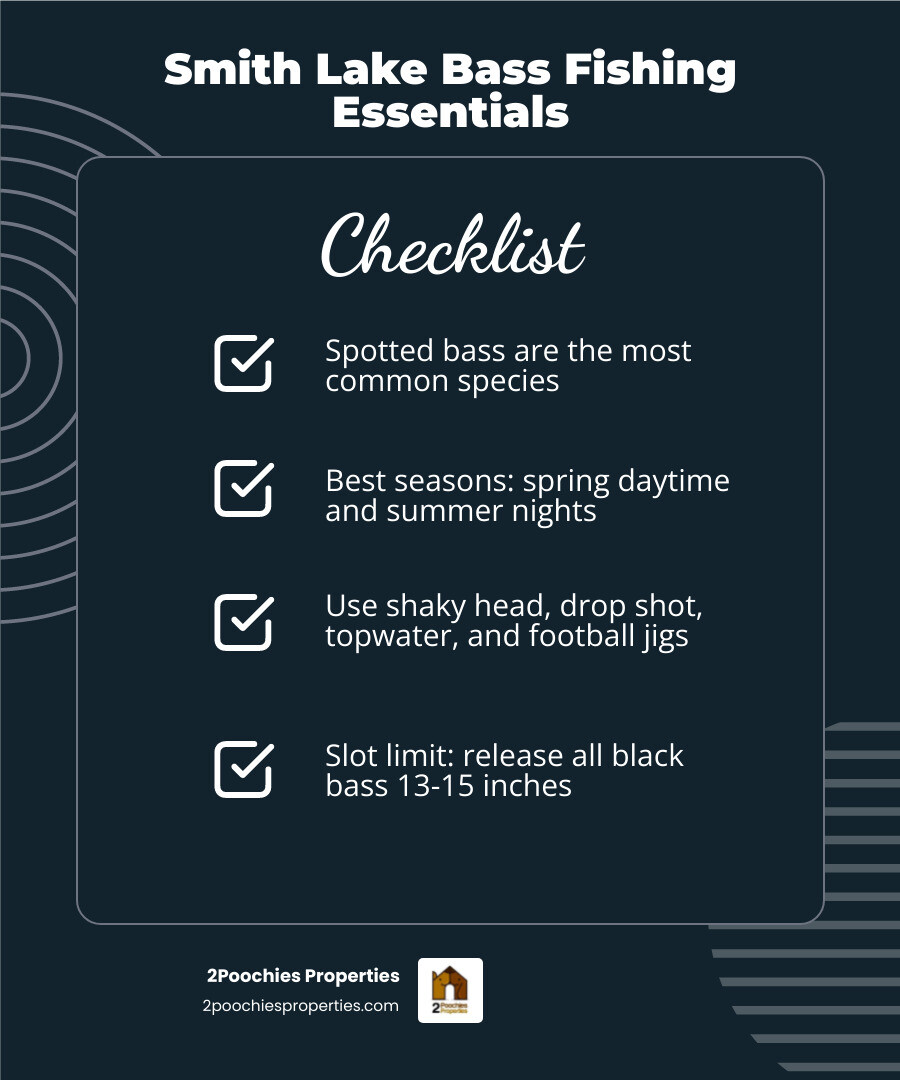
Quick-start guide to bass fishing Smith Lake:
- Main species: Spotted bass (most common), largemouth bass, striped bass
- Best times: Spring and fall for daytime fishing; summer nights after sunset
- Top techniques: Shaky head, drop shot, topwater lures, football jigs
- Key structure: Rocky points, stair-step banks, fallen trees, deep humps
- Slot limit: Immediately release all black bass between 13–15 inches
- What makes it unique: Deep, crystal-clear water up to 264 feet deep — very different from typical Alabama lakes
- Realistic expectations: On a good day, experienced anglers can catch 50–70 spotted bass
Lewis Smith Lake covers 21,200 acres with over 500 miles of shoreline across Walker, Winston, and Cullman counties in North Alabama. It sits about an hour north of Birmingham. The water is deep and unusually clear — more like a mountain lake than a typical Southern reservoir. That clarity changes everything about how you fish it.
I’m Tim Morgen from 2Poochies Properties, and after years of true lakefront living on Smith Lake, bass fishing Smith Lake is something I know from experience — not just from the dock, but out on the water across every season. In the sections below, I’ll walk you through everything a beginner needs to get started with confidence.
Quick look at bass fishing smith lake:
The Unique Ecosystem of Lewis Smith Lake
When we talk about the ecosystem of Lewis Smith Lake, we are talking about a “highland reservoir.” Unlike the stained, shallow waters of the Tennessee River, Smith Lake is a deep-water wonder. In May 2026, as you look down from your boat, you might see 15 feet into the depths. This clarity is beautiful for swimming and boating, but it presents a unique challenge for those of us targeting bass.
The lake spans roughly 21,200 acres and offers a staggering 500 miles of shoreline. Because the lake was created by damming the Sipsey Fork, the terrain is rugged. You aren’t just fishing mud flats here; you are fishing submerged mountains, deep river channels, and vertical rock bluffs. In fact, depth finder readings near the dam can jump to over 200 feet instantly.
For the fish, this means a massive amount of vertical habitat. While a bass in a shallow pond might only have five feet of water to move through, a Smith Lake spotted bass might live in 40 feet of water and move up to 10 feet to feed in a matter of seconds. According to Smith Lake | Outdoor Alabama, this environment supports a diverse fishery including bream, crappie, and three distinct types of bass.
The Impact of Blueback Herring on Bass Fishing Smith Lake
One of the most significant changes to bass fishing Smith Lake in recent decades was the introduction of blueback herring. Originally an illegal introduction in the early 2000s, these baitfish have completely transformed how our local bass behave.
Before the herring arrived, spotted bass were largely “homebodies.” They stayed near brush piles or specific rocky points. Now, they have become nomadic hunters. Blueback herring live in the open water and move in large, shimmering schools. Our spotted bass have learned to follow them.
This forage shift has led to two major outcomes:
- Increased Growth Rates: Spotted bass are getting bigger. It is now common to see tournament limits of five fish weighing over 20 pounds. Individual “spots” can reach 5 to 6 pounds, and they are some of the hardest-fighting fish in Alabama.
- Open Water Patterns: Instead of just casting at the bank, we now spend a lot of time looking at our electronics in open water. If you find the herring, the bass are usually right underneath them.
As we noted in our Dont Get Skunked With The Latest Smith Lake Fishing Report, understanding this “herring bite” is the difference between a frustrating day and a legendary one. Herring move into the creeks in the fall and back to the main lake in the winter, and the bass follow that exact roadmap.
Proven Techniques for Bass Fishing Smith Lake
If you are coming from a background of fishing muddy water with heavy line and big lures, you’ll need to adjust your strategy for bass fishing Smith Lake. Because the water is so clear, the fish can see your line and your lures from a long distance. “Finesse” is the name of the game here.
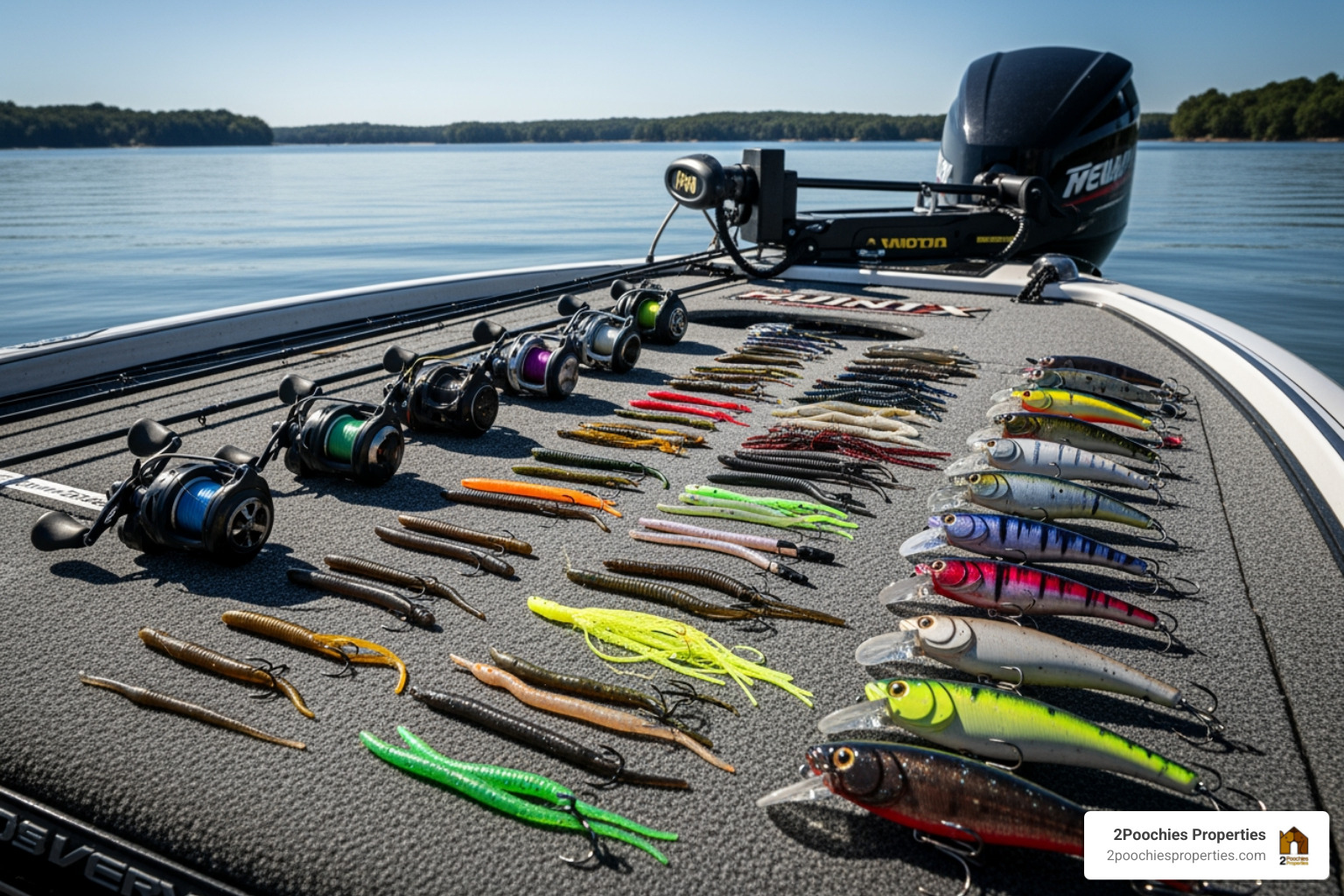
We recommend using lighter gear than you might expect. Many local pros use 6-pound to 10-pound test fluorocarbon line. Fluorocarbon is nearly invisible underwater, which is essential when a spotted bass is staring at your bait in 20 feet of crystal-clear water.
Here are the primary techniques we use:
- The Shaky Head: This is arguably the most productive year-round technique on the lake. It involves a small lead-head jig with a straight-tail finesse worm (usually in Green Pumpkin or Watermelon Red). You let it sink to the bottom and “shake” it gently. It mimics a small baitfish or crawfish feeding on the rocks.
- The Drop Shot: When fish are holding deep—say 25 to 40 feet—a drop shot is king. You tie a hook about 18 inches above a weight. This keeps your bait suspended right in the face of the bass.
- Topwater Lures: During the spring and fall, when the bass are chasing herring near the surface, nothing beats the excitement of a topwater strike. Lures like the KVD Sexy Dawg or a Zara Spook are staples in our tackle boxes.
- Football Jigs: For targeting quality fish on deep rocky points, a 1/2 oz to 3/4 oz football head jig is a great choice. It drags along the bottom and creates a thumping sound that attracts big spots and largemouth alike.
For a deeper dive into these methods, check out our How To Catch More Fish With Our Smith Lake Bass Fishing Guide.
Seasonal Strategies for Bass Fishing Smith Lake
The calendar dictates where the fish will be. In May 2026, we are right in the heart of some of the best fishing of the year.
- Spring (March – May): This is the spawn season. Bass move toward shallow “stair-step” rock banks and pockets. You can catch high numbers of fish—sometimes up to 100 a day—using flukes and shaky heads. Look for fish guarding fry or bedding in the sandy pockets.
- Summer (June – August): As the Alabama heat cranks up, the daytime fishing can get tough. This is when we switch to night fishing. After the sun goes down and the jet skis head home, the bass move onto the points and humps to feed. Heavy spinnerbaits and jigs are the preferred tools for the night shift.
- Fall (September – November): As the water cools, the shad and herring move into the backs of the creeks. The bass follow them in a feeding frenzy. According to Early Fall Bass On Smith Lake, October and November are fantastic months for topwater action and “running and gunning” between points.
- Winter (December – February): The fish move deep. We look for them in 30 to 60 feet of water. Vertical jigging with spoons or using a slow-moving football jig on deep timber can produce some of the biggest fish of the year.
Top Locations and Structure to Target
Smith Lake isn’t just one big bowl of water; it’s divided into several major “arms,” including Ryan Creek, Rock Creek, and the Sipsey Fork. Each has its own personality. Ryan Creek is often busier with boat traffic but holds massive populations of spotted bass. The Sipsey Fork tends to be even clearer and deeper.

When you are out on your pontoon boat, look for these specific types of structure:
- Rocky Points: These are the “intersections” of the lake. Bass use points to ambush baitfish moving in and out of creeks.
- Stair-Step Banks: These look like underwater bleachers made of rock. Bass love to sit on the “steps” at different depths depending on the sun and temperature.
- Fallen Trees: While Smith Lake doesn’t have much grass, it has plenty of “blow-downs.” A large tree that has fallen into the water provides excellent cover for largemouth bass.
- Deep Humps: These are underwater islands that don’t quite reach the surface. They are magnets for schools of spotted bass, especially when the current is moving.
To help you decide what to target, we’ve put together this comparison of our two main black bass species:
| Feature | Spotted Bass | Largemouth Bass |
|---|---|---|
| Primary Habitat | Deep rocky points, open water, humps | Shallow wood, docks, backs of pockets |
| Typical Depth | 15–60 feet | 2–15 feet |
| Aggression Level | High (fights like a freight train) | Moderate (ambush predator) |
| Best Lure | Shaky head, Drop shot, Topwater | Buzzbait, Jig, Frog |
| Population | Dominant (approx. 70-80% of catch) | Less common but grows larger |
For more specific GPS-style advice, read The Best Fishing Spots On Smith Lake For Every Angler.
Regulations and Frequently Asked Questions
Before you launch your boat, it is vital to understand the local laws. Alabama takes its fisheries management seriously, and Smith Lake has specific rules designed to keep the population healthy.
The most important thing to remember is the slot limit. Currently, it is illegal to possess any black bass (spotted or largemouth) between 13 and 15 inches. These fish must be released immediately.
Why? Biologists found that the lake had too many small fish competing for food. By protecting the 13–15 inch “teenagers,” and encouraging anglers to keep a few fish under 13 inches, the remaining fish have more food and grow into 5-pound trophies much faster. As of the last major survey, about 16% of the black bass population exceeds 15 inches, which is a testament to how well this system works.
What are the current slot limits for bass on Smith Lake?
As mentioned, the slot limit covers all black bass between 13 and 15 inches. You are allowed a creel limit of 10 black bass total per day, but none can be within that 13–15 inch range. We always encourage “catch and release” for the big ones, but keeping a few small spots for a fish fry is actually encouraged by the state to help the lake’s health!
Can I catch striped bass while targeting black bass?
Absolutely. Smith Lake is famous for its landlocked striped bass. While you are casting for “spots,” don’t be surprised if a 20-pound striper hammers your topwater lure. These fish are stocked annually and can reach over 40 or even 50 pounds. If you want to target them specifically, live shad or herring are the best baits. Check out Fishing Lewis Smith Lake Like A Pro for more on the “big game” of the lake.
What is the best time of day to fish in summer?
In the heat of July and August, the best time is undoubtedly at night. The “night bite” on Smith Lake is legendary. The water cools down, the boat traffic disappears, and the big bass move shallow to feed. If you must fish during the day in summer, look for deep timber in 40+ feet of water or find docks that provide large areas of shade.
Conclusion
Bass fishing Smith Lake is more than just a hobby; it’s a way of life for us here in North Alabama. Whether you are chasing a 5-pound spotted bass on a finesse worm or watching your kids catch their first bream off a private dock, the memories made on this water last a lifetime.
At 2Poochies Properties, we believe that the best fishing trips are the ones where the whole family—including your four-legged friends—can come along. Our lakefront homes in Crane Hill and across Cullman County are designed with the outdoor lover in mind. We offer pet-safe designs with fenced areas and durable flooring, so you don’t have to worry about your pup after a long day on the boat.
Speaking of boats, we also offer boat rentals to our guests, making it easier than ever to reach those deep humps and rocky points we talked about. After a successful day of fishing, there is nothing quite like a sunset cruise on a pontoon boat followed by a swim in the clear blue water right off your own dock.
Ready to test your skills against the meanest spotted bass in the South? We’d love to host you. From our family to yours, we invite you to experience the “diamond” of Alabama.
Book your Smith Lake lakefront home and start planning your bass fishing adventure today!