
The Ultimate Guide to Renting with Pets
Why Renting and Pets Is One of the Biggest Challenges for Pet-Loving Families
Renting and pets can be a complicated combination — but it doesn’t have to be. Here’s a quick overview of what you need to know:
Quick Answer: Renting with Pets at a Glance
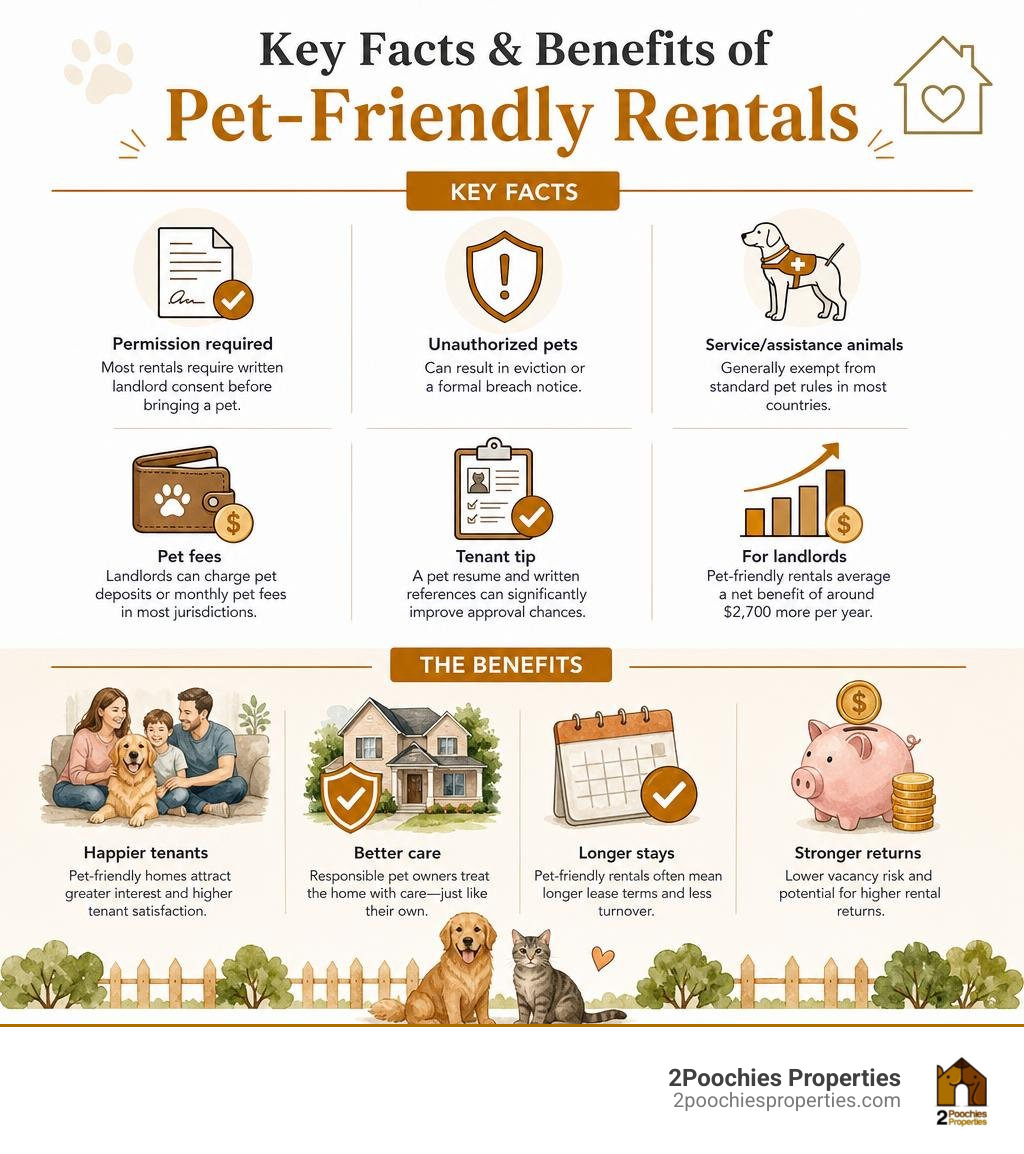
| Topic | Key Fact |
|---|---|
| Permission required | Most rentals require written landlord consent before bringing a pet |
| Unauthorized pets | Can result in eviction or a formal breach notice |
| Service/assistance animals | Generally exempt from standard pet rules in most countries |
| Pet fees | Landlords can charge pet deposits or monthly pet fees in most jurisdictions |
| Tenant tip | A pet resume and written references can significantly improve approval chances |
| For landlords | Pet-friendly rentals average a significant net financial benefit per year |
Finding a place to rent when you have a dog, cat, or other beloved animal is genuinely hard. Only a little more than half of rentals in the US allow pets at all. That leaves millions of pet owners competing for a smaller pool of available homes.
The rules also vary a lot depending on where you live. Laws in New South Wales, Queensland, British Columbia, England, and New Zealand have all changed recently — and what’s allowed in one place may not be allowed in another.
Whether you’re a tenant trying to get approval for your dog or a landlord deciding whether to open your doors to pets, this guide covers everything you need to know — from legal rights and financial implications to practical tips that actually work.
I’m Tim Morgen, owner of 2Poochies Properties, where I specialize in pet-friendly lakefront homes at Smith Lake, Alabama. My hands-on experience with renting and pets — designing spaces that welcome four-legged family members safely and cleanly — gives me a real-world perspective you won’t find in a typical legal guide. Let’s get into it.
Handy renting and pets terms:
Legal Frameworks and Tenant Rights for Renting and Pets
Navigating the legal landscape of renting and pets can feel like walking through a maze. Historically, property owners held absolute power to enforce “no pets” policies. However, modern tenancy laws increasingly recognize that pets are valued family members. Understanding your rights and responsibilities under these updated legal frameworks is essential for a stress-free tenancy.

Global Jurisdictions and Local Laws on Renting and Pets
Depending on where your rental is located, your legal right to request a companion animal varies dramatically. Here is a breakdown of recent legislative shifts across major jurisdictions:
- United Kingdom: Under the Renters’ Rights Act 2025, tenants in assured tenancies have a statutory right to request permission to keep a pet. Landlords must respond to these written requests within 28 days and cannot unreasonably refuse consent. If the landlord requires additional information, the clock can be extended by up to 7 days.
- New Zealand: The Residential Tenancies Amendment Act 2024 establishes that tenants may keep pets if the agreement allows it or if the landlord provides written consent. Landlords must respond to requests within 21 days and can only refuse based on reasonable grounds, such as property suitability or local council limits.
- Australia (New South Wales): Under the updated NSW Government Pet Rules, landlords must respond to formal pet applications within 21 days, or consent is automatically granted. Furthermore, keeping four or fewer animals is generally considered reasonable under rental laws.
- Australia (Queensland): According to the Queensland Renting with Pets guidelines, a property manager has 14 days to respond to a pet request form. Failure to respond within this timeframe results in automatic approval.
- Canada (British Columbia): In BC, the BC Canada Pet Tenancy act states that landlords still retain the right to restrict pets in the tenancy agreement. However, if they do allow them, they can collect a pet damage deposit as permitted under provincial regulations.
If you are looking for local long-term or vacation housing in our specific service regions, including Birmingham, Huntsville, Madison, Nashville, Franklin, and Cullman, we invite you to explore our premier options. For those specifically renting or vacationing near our home base on Smith Lake, make sure to read our comprehensive Smith Lake Pet Restrictions Guide to understand local homeowner association rules and guidelines.
Service Animals, Emotional Support Animals, and Regular Pets
It is critical to distinguish between regular pets, service animals, and emotional support animals (ESAs). Under the law, these categories are treated very differently:
| Animal Category | Definition | Legal Protections | Deposit Requirements |
|---|---|---|---|
| Service Animal | Individually trained to do work or perform tasks for a person with a disability. | Protected under ADA and FHA. Allowed in all housing. | Exempt from pet deposits, pet rent, and pet restrictions. |
| Emotional Support Animal (ESA) | Provides therapeutic comfort to help alleviate symptoms of a mental health disability. | Protected under the Fair Housing Act (FHA) in the US. | Exempt from pet deposits and breed/weight restrictions. |
| Regular Pet | Kept for companionship, personal interest, or ornamental purposes. | Subject to landlord discretion, local bylaws, and lease terms. | Subject to standard pet deposits, fees, and restrictions. |
Certified guide and service dogs are not considered pets under tenancy law. Therefore, landlords cannot restrict them or demand a pet deposit, even in properties with strict “no pets” policies.
Navigating Strata, Body Corporate, and HOA Rules
Even if your landlord is enthusiastic about your pet, another entity might stand in the way: the body corporate, strata committee, or Homeowners Association (HOA).
In many multi-family developments, townhomes, and lakefront subdivisions, by-laws dictate whether pets are allowed. In NSW, by-laws completely banning pets are invalid, but strata schemes can still place reasonable restrictions on pet size and behavior. In Queensland, tenants often need dual approval from both the landlord and the body corporate committee.
If you are renting a vacation property, choosing a home with dedicated amenities can help bypass these headaches. Check out our guide on Finding Vacation Rentals with Fenced Yards and learn how to Secure Your Stay with These Vacation Rentals with Fenced Yard to find properties designed with pet freedom in mind.
Financial and Practical Considerations for Landlords
If you are a property owner, deciding whether to allow renting and pets is a major business decision. While some landlords fear property damage, the statistics show a massive financial upside to adopting a pet-friendly policy.
- More Applications: Since only a limited number of rentals allow pets, opening your doors to animals instantly increases your prospective tenant pool.
- Longer Tenancies: Pet-friendly rentals boast significantly longer lease durations compared to properties that prohibit pets.
- Reduced Vacancies: Housing that permits pets experiences a noticeable reduction in vacancy rates.
- Marketing Savings: Landlords who allow pets save substantially on advertising costs due to high demand and word-of-mouth referrals.
- Minimal Damage Difference: Despite common worries, the average cost of pet-related damage is only slightly higher than standard wear-and-tear damages (averaging only a minimal difference per tenancy).
- Substantial Net Benefits: When accounting for pet rent, faster lease-ups, and long-term tenant retention, landlords who allow pets enjoy a significant net financial benefit annually compared to those who do not.

Best Practices for Landlords Navigating Renting and Pets
To protect your investment while maximizing income, we recommend the following practical strategies:
- Require Renters Insurance: Ensure your tenant’s policy covers pet liability.
- Conduct Move-In Inspections: Always complete a detailed condition report, ideally with photos, before the pet moves in.
- Upgrade Materials: When renovating, install durable vinyl plank flooring and use semi-gloss paint to make cleanup easy.
- Emphasize Sanitation: Work with professional cleaning services. At 2Poochies Properties, we prioritize safety and cleanliness. Learn about our standards in Clean Paws Only in Sanitized Homes to see how we maintain allergy-free, pristine spaces.
How Tenants Can Secure Approval for a Pet
If you are a tenant looking for a home, you need to present yourself as a responsible, low-risk pet owner. Landlords are much more likely to say “yes” if you provide documentation that proves your pet is well-behaved.
Creating a Standout Pet Resume
A pet resume is a highly effective tool to win over hesitant landlords. Your pet’s resume should include:
- Basic Details: Breed, age, weight, and a cute photo (a picture of your dog looking calm and friendly works wonders!).
- Medical Records: Proof of up-to-date vaccinations, flea/tick prevention, and spay/neuter certificates.
- Training Certifications: Proof of obedience classes or Canine Good Citizen (CGC) certifications.
- References: Written letters from previous landlords or neighbors confirming that your pet does not bark excessively or cause damage.
For more inspiration on finding the perfect property, read our Tips to Find Pet Friendly Lake House Rentals or explore our list of top-rated pet-friendly lakefront homes to see what high-quality pet accommodations look like. You can also get ideas for planning tail-wagging getaways with your canine companion.
Understanding Tenant Responsibilities and Nuisance Prevention
Once approved, the responsibility falls on you to maintain a good relationship with your landlord and neighbors. This means managing noise control, cleaning up waste immediately, and protecting the property from damage.
If you are taking your pet on a lake vacation, safety and containment are paramount. Read our guide on Secure Fencing and Crates for Lake Vacations and check out our tips for managing large pet-friendly homes to keep your pup secure. Don’t forget to review the top 7 lake activities for dogs to ensure your dog has a safe, fun-filled time by the water!
Frequently Asked Questions about Renting with Pets
What happens if a tenant keeps a pet without permission?
Keeping a pet without landlord consent is a serious breach of most lease agreements. If discovered, the landlord can issue a formal breach notice requiring you to remove the pet within a specific timeframe (e.g., 14 to 28 days depending on the jurisdiction). If you fail to comply, the landlord may initiate formal eviction proceedings. It is always better to seek written permission upfront.
Can a landlord charge extra fees or non-refundable deposits for pets?
It depends entirely on local laws. In British Columbia, landlords can request a pet deposit, but it is legally capped and must be refundable. In some US states, landlords can charge monthly pet rent or a pet fee. However, non-refundable pet deposits are illegal in several jurisdictions, and landlords cannot charge any pet-related fees for certified service or assistance animals.
What are valid reasons for a landlord to refuse a pet?
Landlords cannot refuse a pet request arbitrarily in areas with modern tenant protections. However, valid reasons for refusal typically include:
- The property lacks adequate fencing or space for the specific animal.
- The pet is classified as dangerous or menacing under local laws.
- By-laws or strata rules for the building strictly prohibit the animal.
- The tenant has a documented history of pet-related property damage or severe noise complaints.
Conclusion
Navigating renting and pets requires a clear understanding of your local laws, open communication, and a proactive approach to property care. Whether you are a tenant looking for a permanent home or planning a relaxing family vacation, finding a space that truly welcomes your pets makes all the difference.
At 2Poochies Properties, we believe that dogs are family. We specialize in providing premier, pet-safe lakefront homes on beautiful Lewis Smith Lake, Alabama. Our properties feature durable flooring, professional sanitization, and secure fenced areas so your entire family can relax. Spend your days swimming off the dock, exploring the water with our convenient boat rentals, and enjoying quality time together.
To avoid extra platform fees and secure the absolute best experience, we highly encourage you to book direct with us. Booking direct ensures a seamless, personalized stay without unnecessary third-party costs. To learn more about our beautiful lake location, visit the Lewis Smith Lake Information page, and when you’re ready to plan your perfect pet-friendly getaway, Contact 2Poochies Properties directly!