
Water intoxication in dogs happens when a dog swallows far more water than the body can balance, which dilutes sodium in the blood and makes cells swell, including brain cells. If your dog has been swimming or playing in water and seems wobbly, bloated, lethargic or is vomiting, call a vet or an emergency animal hospital right away. Do not wait to see whether it passes. The good news is that a few simple habits make lake and pool days much safer.
TL;DR
- Water intoxication (also called hyponatremia) comes from swallowing too much water, often during long swims, retrieving or hose play, and it can progress to seizures.
- Warning signs include lethargy, bloating, vomiting, loss of coordination, drooling, pale gums and glazed eyes. Any of them after heavy water play means calling a vet immediately.
- Do not treat it at home with salt or electrolyte products. Treatment is controlled fluid and electrolyte therapy from a veterinarian.
- Prevent it with a break about every half hour, fresh drinking water, flat floating toys and close supervision.
- Smaller dogs and high-drive retrievers deserve extra attention around water.
Table of Contents
- What water intoxication in dogs actually is
- Which dogs and activities carry the most risk
- Symptoms of water intoxication in dogs
- What to do if you suspect it
- How to prevent water intoxication at the lake or pool
- Lake water has a second hazard: blue-green algae
- Our perspective
- Planning a pet-friendly lake stay
- FAQ
- Sources
What water intoxication in dogs actually is
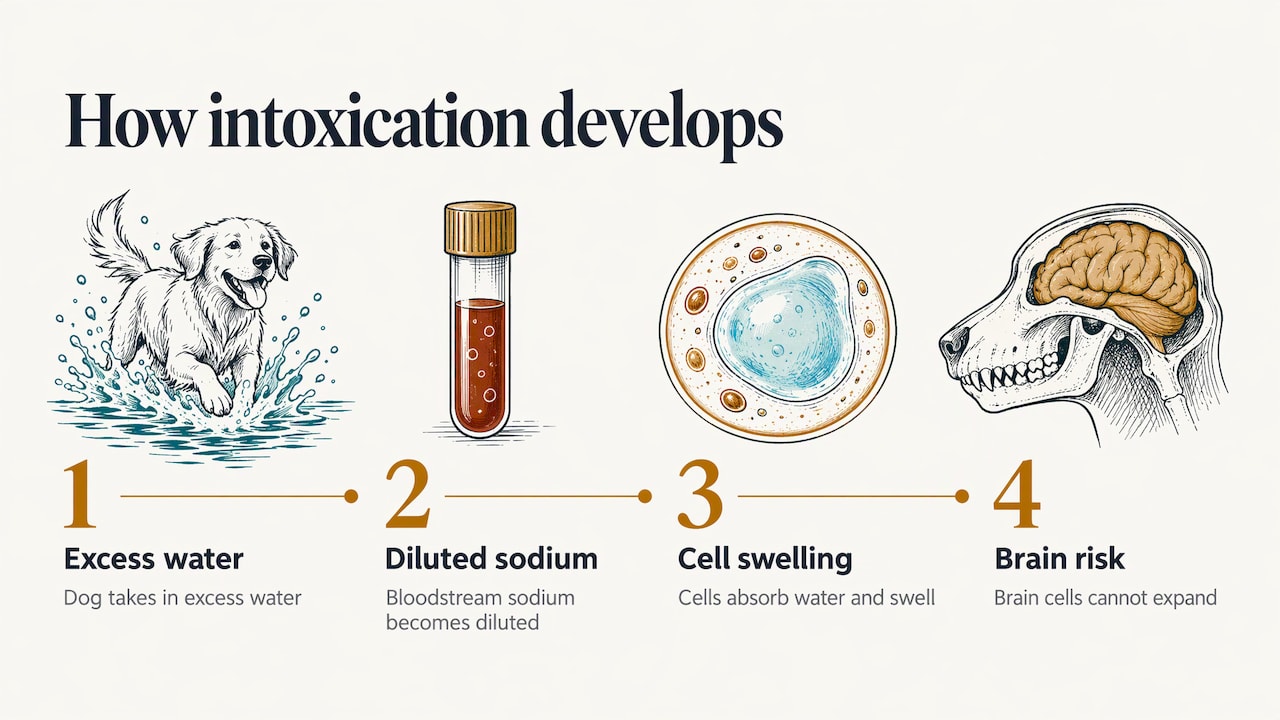
The condition goes by several names: water intoxication, water toxicity, hyperhydration and hyponatremia. They all describe the same problem. A dog takes in so much water that the sodium in its bloodstream becomes diluted. Cells react by absorbing water and swelling. Swelling in most tissues is a nuisance, but brain cells have nowhere to expand, which is why the condition can become dangerous so quickly.
The UK charity PDSA explains that it can happen when a dog swims for a long time, fetches a toy from a river, or plays with water from a garden hose. Cornell’s veterinary college adds that fresh-water intoxication can occur when a dog spends all day in a pool or lake, especially while chasing balls or sticks.
Notice what these examples have in common. The dog is not guzzling from a bowl. It is gulping water by accident, over and over, while it is excited and focused on something else. That is why the problem tends to show up on holidays, at lakes and around pools, and not on an ordinary day at home.
Which dogs and activities carry the most risk
Any dog that swims or plays in water can take in too much, but some situations raise the odds. The American Kennel Club notes that toy and small dogs are at greater risk than larger dogs, simply because it takes less water to upset their balance.
The same source lists behaviors that increase risk:
- Splashing with the head low and the mouth open
- Retrieving objects from the water
- Diving for toys
- Biting at a hose or sprinkler stream
High-drive dogs deserve special mention. A dog that lives for the next throw will often push through discomfort and keep going. Your dog will not tell you it has had enough, so you have to make that call for it.
Situations worth watching closely
- Long retrieving sessions. Every time the dog grabs a ball in the water, it may swallow some.
- Dock and boat jumping. Repeated jump, swim, climb, jump cycles mean a lot of open-mouth splashing.
- Hose and sprinkler games. Biting at a stream of water sends a lot of it straight down.
- Pool days with no breaks. Excited dogs may not stop on their own.
Symptoms of water intoxication in dogs
The AKC lists these signs: lethargy, bloating, vomiting, loss of coordination, restlessness, drooling, pale gums, dilated pupils and glazed eyes. They can come on suddenly and may progress to difficulty breathing, seizures or coma. PDSA also reports passing unusually large amounts of clear urine after water exposure as a sign.
People often describe the early picture as a dog that suddenly seems “drunk”: staggering, uncoordinated, drooling, unwilling to keep playing. A dog that was bouncing around ten minutes ago and now lies down or wobbles is telling you something.
How fast can it happen?
Quickly. PDSA describes dogs becoming very poorly very quickly, and warns that brain swelling can cause irreversible damage before the kidneys have a chance to restore balance. Cornell notes that severe cases can involve brain swelling, seizures and other neurological problems, and may lead to death. That is the reason for the rule in the next section: act on the first sign, not the third.
What to do if you suspect it
This is a situation for a veterinarian, not for home remedies.
- Get the dog out of the water and stop all play.
- Call your vet or the nearest emergency animal hospital immediately. Tell them how long the dog was in the water, what it was doing and which symptoms you see. PDSA advises contacting a vet right away after any suspected symptom following substantial water play, rather than watching and waiting.
- Do not try to fix it with salt or electrolyte products. PDSA specifically says not to restrict water at home with salt or electrolyte products, and the AKC warns that super-concentrated sodium can cause severe neurological problems.
- Head to the clinic. Travel while you have someone to drive so another person can watch the dog.
How urgent is it? The Animal Emergency & Referral Center of Minnesota draws a useful line. Mild lethargy, vomiting or bloating still need prompt evaluation. Difficulty breathing or seizures are a true emergency that needs immediate veterinary care. If you are unsure which category you are in, treat it as the more serious one and call.
What the vet will likely do
Expect blood tests to check electrolytes, then fluids to bring levels back slowly. PDSA notes treatment may include a diuretic. The word “slowly” matters. Today’s Veterinary Practice explains that sodium must be restored carefully, because correcting it too fast can itself cause neurologic injury. That is why this is a job for controlled veterinary therapy and not something to attempt with kitchen supplies. The same publication describes a clinical protocol using intravenous saline for acute cases, with close monitoring. It is a hospital procedure, not a home treatment, and it is mentioned here only so you understand why the clinic will want to keep your dog under observation.
How to prevent water intoxication at the lake or pool
Prevention is mostly about rhythm and supervision. None of it requires keeping your dog out of the water.
Build in breaks
Cornell recommends frequent half-hour breaks during swimming or lake play to give the body’s fluid-balancing system time to adjust. Set a phone timer. When it goes off, bring the dog out of the water, let it rest in the shade, and offer fresh water from a bowl.
Choose the right toys
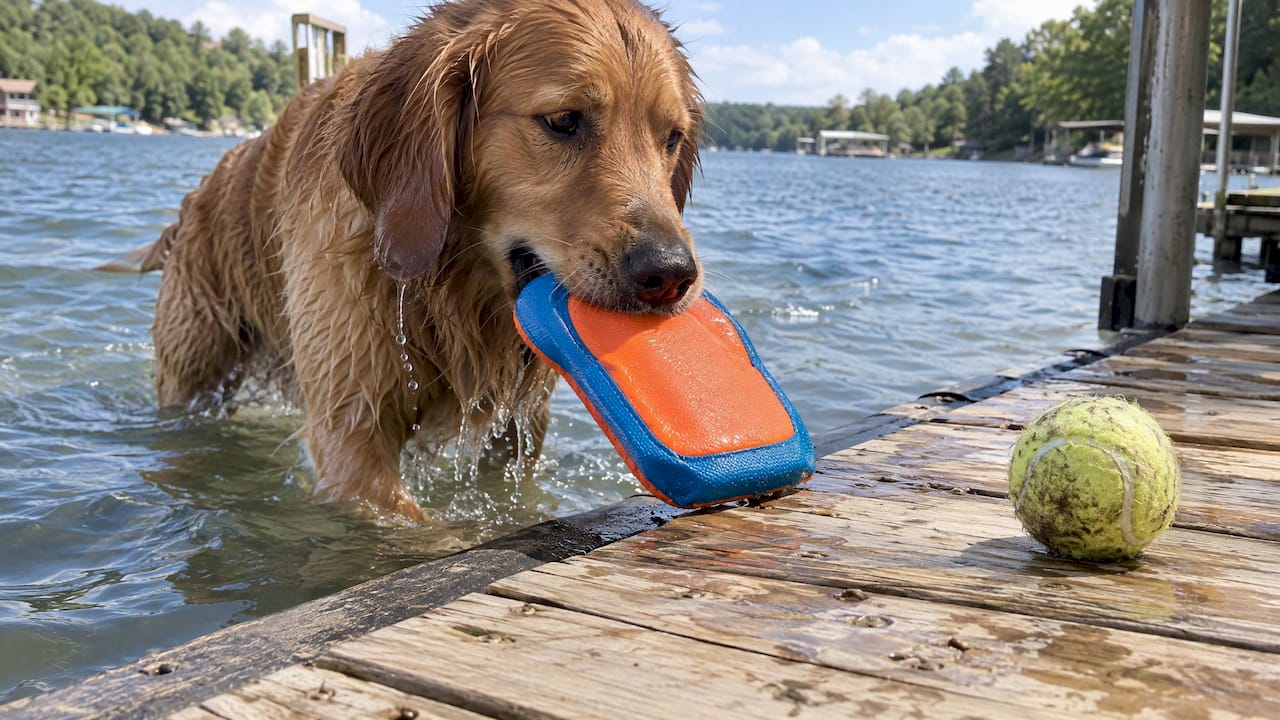
The AKC suggests flat floating retrieval toys instead of tennis balls or other rounded toys, and advises avoiding diving toys. A flatter object lets the dog close its mouth more tightly, which may reduce the water swallowed.
Watch the mouth, not just the splash
If your dog swims with its mouth wide open, scoops water as it paddles or snaps at spray, shorten the session. Skip hose games that encourage biting at the stream.
Pay extra attention to small dogs
Because toy and small dogs are at higher risk, give them shorter water sessions and more frequent breaks, and keep them in shallow areas where they can stand and rest.
Keep the pool or dock safe
Water safety is wider than intoxication. Guide Dogs for the Blind recommends teaching your dog where the exits or steps are, using fencing or a suitable cover when a pool is unattended, and never leaving a dog unsupervised. They also note that tired dogs may not be able to climb out on their own. A dog that has been swimming for a long time is a tired dog, so this matters more late in a session.
| Habit | Why it helps | When to do it |
|---|---|---|
| Break every 30 minutes | Gives the body time to adjust its fluid balance | Any extended swim or retrieving session |
| Fresh drinking water on shore | Reduces the urge to gulp lake or pool water | At every break |
| Flat floating toys | Lets the dog close its mouth more tightly | Fetch in the water |
| No diving toys | Avoids open-mouth underwater grabbing | Pool and lake play |
| Learn the exits | Tired dogs may struggle to climb out | Before the first swim |
| Constant supervision | Lets you spot the first signs early | Whenever the dog is near water |
Lake water has a second hazard: blue-green algae
Water intoxication is not the only reason to watch your dog around lakes. Blue-green algae poisoning is a separate problem with different causes, though some symptoms overlap, such as lethargy, vomiting and seizures. The Wisconsin Department of Natural Resources advises keeping dogs out of water that looks like pea soup, green or blue paint, or that has scum or floating blobs. It also recommends offering fresh water instead of lake water, preventing dogs from licking algae off their coats, and washing them after exposure.
Cornell likewise recommends only clear, cool, moving water for dog swimming. Take a moment before every swim to look at the water. If it looks off, pick another spot or skip the swim that day. That is Wisconsin’s advice, but the habit of checking the water applies at any lake.
Our perspective
We built our business around one idea: a lake vacation should include the dog, and the dog should be safe and comfortable while it is there. Water is the whole point of a lake trip, so we think about it constantly.
What we tell families is simple. Plan the day around the dog’s energy, not just yours. A dog that has the run of a fenced yard, a shaded spot near the dock and a bowl of fresh water within reach is much easier to give regular rests to than a dog tied to the edge of the action. Our homes are set up with pets in mind, with fenced yards, dog beds and cleanup stations, so breaks feel natural and not like a chore.
We also like guests to talk to us directly before they arrive. Tell us about your dog: small or large, a swimmer or a wader, a ball obsessive or a gentle paddler. Because we handle bookings personally, we can answer practical questions about the home and the dock area while you are planning. Then you can build a routine of swim, rest, drink, repeat from the first afternoon.
Know the warning signs, keep the timer running and call a vet at the first sign of trouble. A safe dog is a happy dog, and a happy dog makes the whole trip better.
Jeremy
Planning a pet-friendly lake stay
If you are heading to Smith Lake in Alabama with your dog, the setting you stay in can make water safety easier. We offer pet-friendly vacation homes at Smith Lake with fenced yards, lakefront locations, swimming docks, dog beds and cleanup stations, all professionally cleaned. You can see the full list on our page for pet-friendly houses for rent on Smith Lake, and book direct with personalized service.

If your group wants time on the water without the dog in it, we also run boat rentals. Our boat rentals at Barney’s Bluff are listed from $200 to $1,200, and Tigua’s Sunrise rentals from $450 to $1,200. You can add a 3-person towable tube with a 60-ft tow rope and booster ball for $125, or a 26-quart Yeti cooler for $25. A boat day is a good chance to give the dog a long rest on shore or in the shade of the house between swims.
A simple lake-day routine
- Check the water before you let the dog in.
- Show the dog the steps or exit points at the dock.
- Start a 30-minute timer when the dog starts swimming.
- Use a flat floating toy for fetch.
- At the timer, leave the water for shade, fresh water and a rest.
- Rinse the dog after swimming, and keep an eye on it for the rest of the day.
- If anything seems off, call a vet before the next swim.
FAQ
What are the symptoms of water intoxication in dogs?
Common signs are lethargy, bloating, vomiting, loss of coordination, restlessness, drooling, pale gums, dilated pupils and glazed eyes, according to the AKC. Large amounts of clear urine after water play are also reported. Signs can appear suddenly, so call a vet at once if you see any of them after heavy water play.
How do you treat a dog with water intoxication?
You don’t treat it at home. A veterinarian will test electrolytes and give fluids to restore them slowly, sometimes with a diuretic. Do not give salt or electrolyte products yourself. Call a vet immediately and, if there is difficulty breathing or a seizure, go to an emergency hospital right away.
Can a dog get water intoxication from swimming in a lake or pool?
Yes. Dogs can swallow a lot of water while swimming for a long time, retrieving toys or biting at a hose or sprinkler. Cornell notes it can happen when a dog spends all day in a pool or lake chasing balls or sticks. Regular breaks and flat floating toys lower the risk.
How often should my dog take a break from swimming?
Cornell recommends a break about every half hour during swimming or lake play. Use the break for shade, rest and fresh water from a bowl. Small dogs and dogs that are intensely focused on fetch may need shorter swim sessions.
Is blue-green algae the same as water intoxication?
No. Blue-green algae poisoning comes from toxins in the water, while water intoxication comes from swallowing too much water. Both can cause serious illness, so avoid water that looks scummy, green or like paint, and call a vet if your dog seems unwell after any swim.
Sources
- PDSA: What is water intoxication in dogs, and why is it dangerous?
- Cornell University College of Veterinary Medicine: Summer safety tips
- American Kennel Club: Water Intoxication in Dogs
- Animal Emergency & Referral Center of Minnesota: Understanding Water Intoxication in Pets
- Today’s Veterinary Practice: Evaluation and Management of the Hyponatremic Patient
- Wisconsin DNR: Blue-Green Algae Risks
- Guide Dogs for the Blind: Water Safety for Dogs