
In Depth Guide to Smith Lake Shellcracker Fishing Spots
Start Smith Lake Shellcracker Fishing on Shallow Hard Bottom
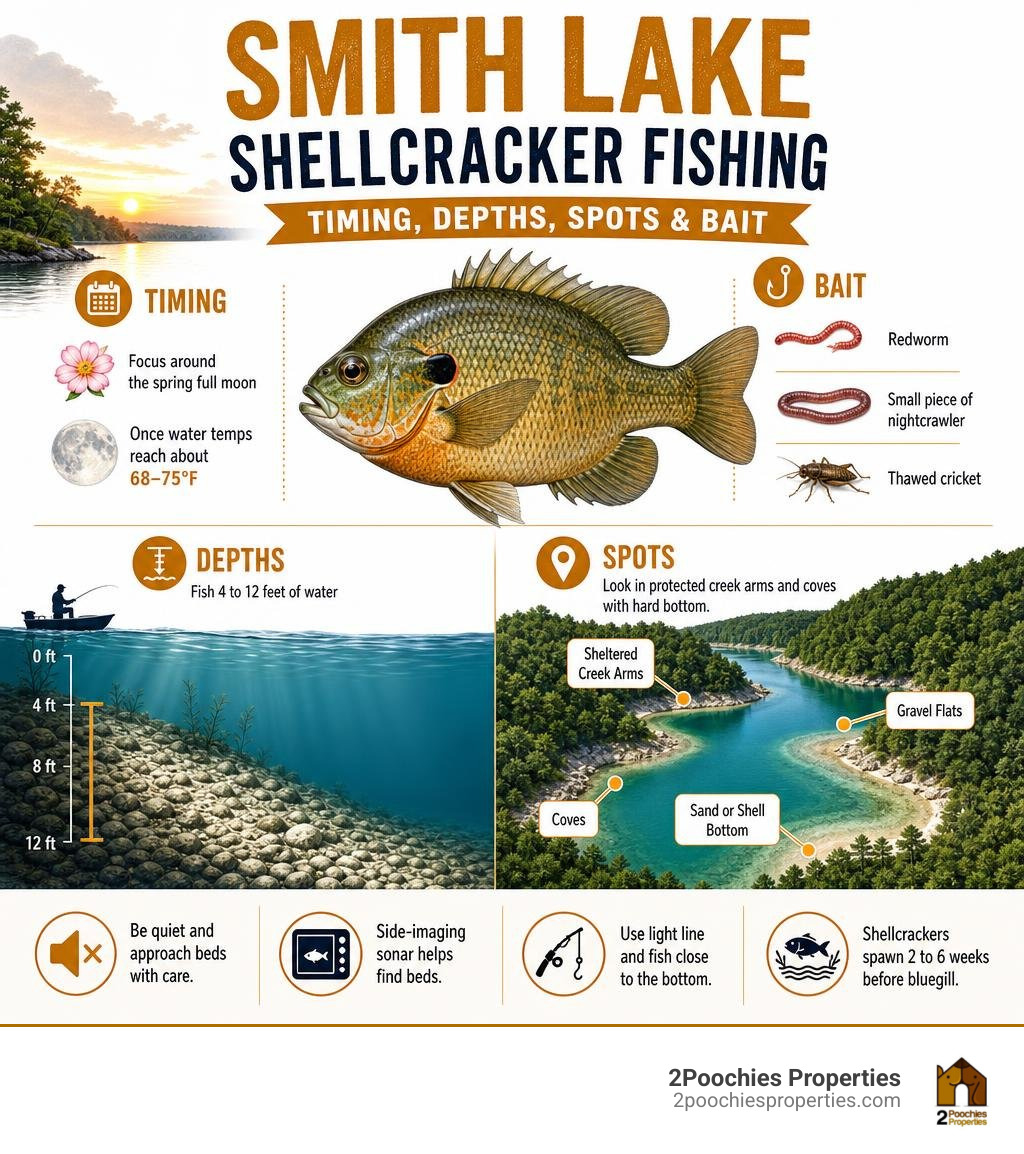
For the best Smith Lake shellcracker fishing, look in protected creek arms and coves for firm gravel, sand, or shell-covered bottom in roughly 4 to 12 feet of water. Fish a redworm, small piece of nightcrawler, or thawed cricket close to the bottom on light line, then focus your search around the spring full moon once water temperatures reach about 68 to 75 degrees.
Shellcrackers, also called redear sunfish, often spawn two to six weeks before bluegill. On Lewis Smith Lake’s clear water, that usually means finding beds may require more scouting than simply casting along the bank. Side-imaging sonar can help reveal circular beds, while a quiet approach and a small, natural bait can make a major difference.
Smith Lake is deep and clear, but its sheltered bays, gravel flats, and creek pockets give shellcrackers the shallow hard-bottom habitat they need during the bedding period. This guide will help you narrow down the best areas, timing, rigs, and tackle so you can spend less time guessing and more time watching the line move.
I am Tim Morgen, part of the team behind 2Poochies Properties, where we welcome families and pets to clean, secure lakefront homes in Crane Hill on Smith Lake. Through helping guests plan fishing-focused stays, I have learned that successful Smith Lake shellcracker fishing starts with matching the lake’s clear-water conditions to the fish’s bottom-oriented habits.
Relevant articles related to smith lake shellcracker fishing:
Understanding Redear Sunfish Biology and Habitat in Lewis Smith Lake
Targeting redear sunfish (Lepomis microlophus) effectively requires understanding what makes them unique among freshwater panfish. Known across the South as shellcrackers, these fish possess specialized pharyngeal teeth—hard, molar-like plates situated in their throats designed specifically to crush snail shells, aquatic insects, and freshwater mollusks.
In Lewis Smith Lake, their diet heavily revolves around small snails, insect larvae, and introduced Asian clams. Because Asian clams thrive primarily in water depths of 15 feet or less over firm substrates, shellcrackers spend the vast majority of their lives patrolling hard bottom flats, submerged humps, and gravel shelves.
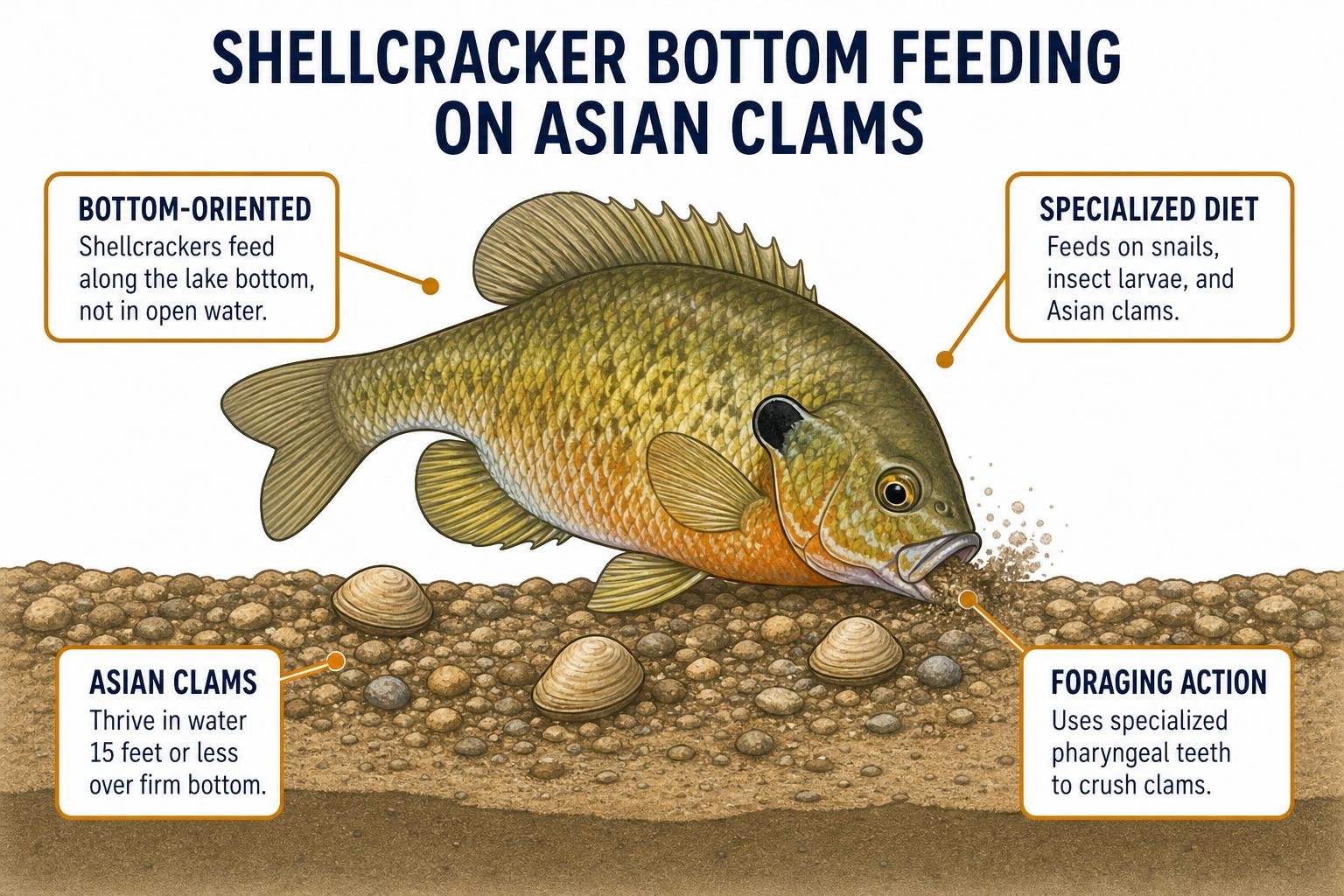
Unlike other sunfish that suspend near boat docks or open-water bait schools, shellcrackers are true bottom-feeders. They scour the lakebed, often disturbing the silt to uncover buried invertebrates. When scanning prospective spots on Smith Lake, look for transitional areas where soft sediment meets pea gravel, sandstone ledges, or submerged clam beds.
Shellcracker vs. Bluegill: Key Behavioral Differences
While shellcrackers and bluegills share the same waters, their habits diverge significantly. Anglers targeting panfish on Smith Lake should recognize these differences to adapt their techniques accordingly.
| Feature / Trait | Shellcracker (Redear Sunfish) | Bluegill (Lepomis macrochirus) |
|---|---|---|
| Primary Forage | Snails, clams, midge larvae, worms | Insects, small minnows, zooplankton |
| Water Column Zone | Strict bottom feeder | Mid-depth to surface, around cover |
| Spawning Timing | Early spring (68–75°F), 2–6 weeks before bluegill | Late spring through summer (75–85°F) |
| Spawning Depth | 4 to 12 feet (deeper in clear water) | 1 to 5 feet (often visible along banks) |
| Distinguishing Mark | Bright red/orange margin on opercular flap | Solid dark blue/black opercular flap |
| Average Body Size | 1 to 2+ lbs (thick, disc-shaped body) | 0.25 to 0.75 lbs (occasional 1 lb fish) |
Shellcrackers spawn earlier in the year than bluegills, moving into staging areas when the water first warms in April or May. Because Smith Lake features exceptional water clarity—often exceeding 10 to 15 feet of visibility—shellcrackers rarely build nests in ultra-shallow shoreline pockets where bluegills typically congregate. Instead, they bed slightly deeper, using contour breaks and gentle slopes to stay hidden from overhead predators.
Target Size, Weight Expectations, and Trophy Potential
Shellcrackers are the heavyweights of the sunfish family. While an average Smith Lake bluegill weighs under half a pound, shellcrackers commonly reach 1 to 2 pounds, offering incredible drag-pulling power on ultralight tackle.
The state of Alabama has a storied history of producing giant panfish, including the historic 4 lb 12 oz world-record bluegill taken from Ketona Lake in nearby Tarrant City. While Smith Lake is best known for its spotted bass and striped bass, its fertile, clear creek arms provide the nutrient foundation for true trophy redears. Anglers working the proper gravel points and clam flats regularly hook into thick, saucer-sized fish measuring 10 to 12 inches.
To fish these waters legally, ensure you carry an up-to-date fishing license through the Alabama Department of Conservation and Natural Resources.
Best Seasonal Patterns for Smith Lake Shellcracker Fishing
Locating shellcrackers on Smith Lake depends largely on water temperature and seasonal transitions. Tracking conditions via our latest Smith Lake fishing report helps zero in on daily movements, but understanding broad seasonal patterns ensures year-round angling success.
In late winter and early spring, shellcrackers stage on secondary points leading into major creek arms. As warming trends take hold, schools migrate into 4- to 12-foot zones across sheltered bays. Following the spawn, post-spawn adults transition outward to deeper offshore humps, rock ledges, and submerged creek channels in 15 to 25 feet of water to escape heavy summer boat traffic and high surface temperatures.
Water Temperature Triggers and the Spring Spawning Moon Phases
The premier window for targeting trophy shellcrackers opens when surface water temperatures climb into the 68°F to 75°F range. This biological trigger typically coincides with the full moon cycles in April and May.
During these periods, large colonies of shellcrackers construct circular nesting beds side-by-side over hard gravel flats. On sonar screens, these bedding colonies appear as dense clusters of dimples resembling a halved golf ball. Spawning activity peaks in waves around the full moon, offering intense action for anglers who present live bait directly across the nests. A secondary, lesser-known spawn can also occur in early autumn (September and October) when cooling water temps briefly re-enter the low 70s.
How Smith Lake Compares to Caney Lake and Kentucky Lake
When evaluating shellcracker destinations, anglers often compare Smith Lake to legendary fisheries like Louisiana’s Caney Lake or Tennessee/Kentucky’s Kentucky Lake.
- Caney Lake: Famous for dominating the Louisiana state-record books with routine 2-pounders, Caney features massive flats carpeted in Asian clams. However, its layout makes finding fish difficult without specialized underwater cameras.
- Kentucky Lake: Renowned for massive numbers—where groups frequently log hundreds of panfish per trip around May full moons—Kentucky Lake features broad, shallow bays that warm rapidly.
- Lewis Smith Lake: Smith Lake is a deep highland reservoir featuring over 500 miles of rugged shoreline and depths exceeding 200 feet. While Smith Lake requires more finesse due to its gin-clear water, its sheltered creek pockets provide highly concentrated populations of quality redears that receive significantly less fishing pressure than bass or crappie.
To explore more about navigating the diverse species of this clear reservoir, consult our ultimate guide to Lewis Smith Lake fishing.
Top Locations and Hotspots Across Lewis Smith Lake
Finding productive spots requires evaluating structure rather than just looking at shoreline brush. Reviewing the best fishing spots on Smith Lake for every angler provides an excellent baseline, but shellcrackers demand specific bottom composition.
Key Hotspots: Main Lake vs. Creeks for Smith Lake Shellcracker Fishing
The main lake channel of Smith Lake drops rapidly into extreme depths, often featuring steep rock bluffs and high boat wake activity. Consequently, the main lake is rarely optimal for shellcracker bedding.
Instead, focus your efforts on the major tributary creeks and protected embayments:
- Protected Coves: Seek out secondary pockets that shield the water from strong spring winds and boat wakes.
- Gravel Flats: Look for gently sloping banks composed of pea gravel rather than sheer rock.
- Silt-to-Hard Transitions: Use sonar to locate transitional flats where soft mud turns to hard sand or clam beds in 6 to 10 feet of water.
Navigating Sipsey Fork, Ryan Creek, and Rock Creek Flats
Three major creek systems offer the best shellcracker habitat on Smith Lake:
- Sipsey Fork Headwaters: The upper Sipsey Fork provides current breaks, sediment bars, and protected side cuts that warm up earlier in the spring than the main body.
- Ryan Creek: Featuring numerous broad pockets and gravel points, Ryan Creek is a powerhouse for numbers. Launching near Smith Lake Park gives immediate access to fertile secondary coves.
- Rock Creek: This secluded arm boasts excellent water quality and numerous shallow humps that hold large shellcrackers before and after the spawn.
Anglers wanting localized pointers can connect with experienced local guides. Review our breakdown of the best Smith Lake fishing guides to book an on-the-water learning session.
Essential Gear, Rigs, and Baits for Big Bream
Because Smith Lake features crystal-clear water, heavy tackle will spook wary redears. Downsizing your line and terminal tackle is essential. Be sure to review standard guidelines in our guide to Lewis Smith Lake fishing regulations before rigging up.
Light Tackle and Rigs for Smith Lake Shellcracker Fishing
Set aside heavy bass gear in favor of ultralight spinning setups designed for sensitivity and subtle bite detection:
- Rod: 6’6″ to 7’0″ light or ultralight, fast-action spinning rod (such as a crappie/panfish special).
- Reel: 1000 to 2000 size spinning reel with a silky-smooth drag.
- Line: 4 lb to 6 lb test high-visibility monofilament (for tracking line twitches) paired with a 2-foot leader of 4 lb fluorocarbon to remain invisible in the gin-clear water.
Top Rigging Options:
- Downsized Carolina Rig: Thread a 1/8 to 1/4 oz egg sinker onto your mainline, add a small barrel swivel, and tie on an 18-inch fluorocarbon leader with a size #6 or #8 light wire bream hook. This keeps your bait pinned right on the bottom while allowing fish to take the bait without feeling immediate resistance.
- Drop Shot Rig: Tie a small size #8 hook 12 inches above a 1/8 oz drop-shot weight. This keeps the worm hovering just above the silt layer.
- Split-Shot Rig: Place a small removable split shot 10 to 12 inches above the hook, paired with a small pencil float set slightly deeper than the bottom depth to detect subtle lift bites.
Live Bait Selections: Redworms, Cold Crawlers, and Frozen Crickets
Artificial lures rarely outperform live bait when targeting selective shellcrackers. Keep these top offerings in your boat cooler:
- Redworms (Wiggler Worms): The gold standard. Thread a whole, lively redworm onto a size #6 Eagle Claw hook, leaving the tail wiggling freely.
- Cold Nightcrawlers: Keep large nightcrawlers cold in a cooler. Pinch off a 1-inch segment and thread it onto the hook, leaving minimal tag ends so the fish swallow the bait cleanly without pulling it off.
- Thawed Frozen Crickets: A classic southern tactic. Storing crickets frozen and thawing them on the deck creates a soft, scent-rich bait that shellcrackers readily take off the bottom.
Frequently Asked Questions About Smith Lake Shellcracker Fishing
What depth do shellcrackers spawn on Smith Lake?
Due to Smith Lake’s exceptional water clarity, shellcrackers typically spawn deeper than in dingy reservoirs, creating beds in depths ranging from 4 to 12 feet. On exceptionally clear gravel flats, beds may even extend down to 14 feet.
What is the best live bait for Smith Lake shellcrackers?
Live redworms and small 1-inch cuts of cold nightcrawlers are consistently the most productive baits on Smith Lake. Because shellcrackers feed primarily on the bottom, live worms resting directly on or just above gravel beds trigger immediate feeding responses.
Can anglers catch shellcrackers in Smith Lake outside of spring?
Yes. Outside of the spring spawn, shellcrackers migrate to deeper offshore humps, rock piles, and submerged channel ledges in 15 to 25 feet of water. Targeting these summer and fall structures with drop-shot rigs or Carolina-rigged live bait produces quality catches year-round.
Conclusion
Smith Lake shellcracker fishing provides an exceptional blend of active rod-bending excitement, beautiful scenery, and rewarding table fare. Whether you are searching for beds in Ryan Creek, drifting flats along Sipsey Fork, or casting off quiet lakefront points in Cullman County, targeting redears on light tackle is an unforgettable North Alabama experience.
When planning your Lewis Smith Lake fishing getaway, stay close to the best angling waters in Crane Hill. At 2Poochies Properties, we offer clean, comfortable, and fully pet-friendly lakefront homes featuring secure fenced areas, durable flooring, and direct dock access.
(Please note: While our vacation homes are proudly pet-friendly, our separate pontoon boat rentals are strictly non-pet-friendly to maintain safety and pristine conditions for all boaters).
Skip third-party booking fees and save by booking direct. Book your stay directly with 2Poochies Properties today and get ready to hook into trophy Smith Lake shellcrackers!