
The safest crate for a car is one that fits your dog snugly, is strapped down so it can’t slide, and sits in the back seat or cargo area, never loose and never in an open truck bed. Get those three things right and a long drive gets much easier. Your dog is contained, you aren’t distracted, and you both arrive ready to relax. We host families and their dogs at Smith Lake, Alabama, so this guide follows the whole trip, from measuring the crate to the first walk around a fenced yard.
Key Takeaways
- Choose a crate your dog can stand, turn around and lie down in, without much spare room. Look for independent crash-test certification for that exact model and size.
- Secure the crate with straps or the manufacturer’s tie-down points, in the back seat or cargo area. Push on it firmly: if it moves, tighten it.
- Build up to the trip with short drives, feed 3 to 4 hours before leaving, and stop every few hours for water and a leashed walk.
- Know the signs of motion sickness and anxiety, and talk to your vet before the trip if your dog struggles in the car.
- Book a pet-friendly home directly so the arrival is as easy as the drive: a fenced yard, dog beds and cleanup stations waiting for you.
Table of Contents
- Why a crate is worth the effort
- How to choose the right crate
- How to secure a crate in your car
- Getting your dog ready for a long car ride
- Motion sickness and travel anxiety
- Arriving: the best part of the trip
- Stay with us at Smith Lake
- Our perspective
- FAQ
- Sources
Why a crate is worth the effort
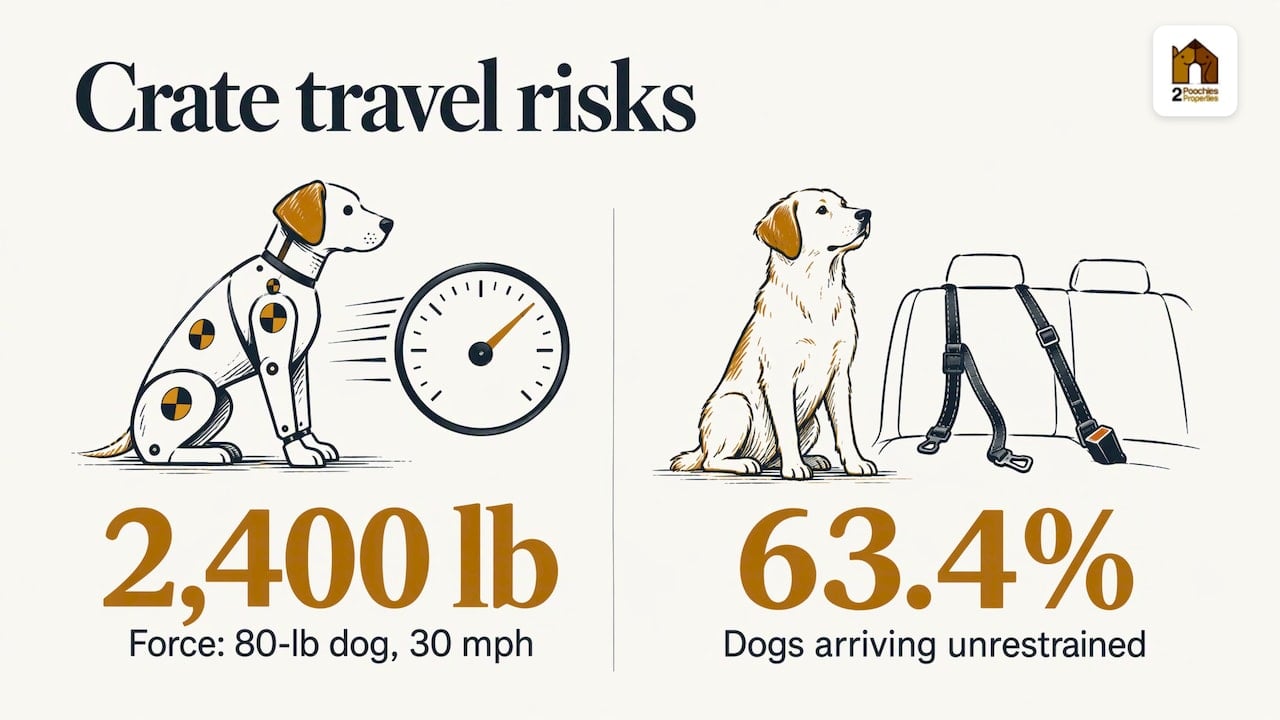
A dog loose in a car is a risk to itself and to everyone inside. CNN Underscored reports that an 80-pound dog exerts about 2,400 pounds of force in a 30-mph collision. It also reports that Center for Pet Safety crash tests sent a dog dummy in a plain wire crate through a car’s seat back.
Most dogs still ride unrestrained. In a 2024 survey at one U.S. veterinary teaching hospital, 63.4% of dogs arrived with no restraint. The AVMA’s policy on non-commercial pet transport, updated in January 2024, keeps stressing the risks of traveling without an appropriate restraint, in the cabin or the cargo area.
Injuries also happen without a crash. Rex Vet notes that dogs are thrown into dashboards during hard braking, fall from open windows or truck beds, and suffer heat exposure in parked cars. A well-fitted, secured crate addresses the first two. It also gives an anxious dog a familiar den.
How to choose the right crate
Fit the dog
The CDC says a travel crate should let your dog stand, sit, lie down and turn around, and it should be well ventilated. For the car, bigger is not better. CNN Underscored’s guidance is that a dog should fit curled up, touching about three sides. Extra room lets a dog be jostled around in a hard stop.
Measure before you shop:
- Length: nose to base of tail, plus a few inches. Zoetis Petcare suggests 2 to 4 inches.
- Height: your dog’s height sitting, head to floor, plus a few inches.
- Shoulder width: the crate must be wide enough for your dog to turn.
- Your vehicle: the cargo floor or seat width, and the hatch or door opening. A crate that fits the dog can still fail to fit the car, or be too heavy to lift in.
Pick a sturdy build
The VCA animal hospitals’ guidance says collapsible wire crates are not sturdy enough to protect a dog in a car. It describes plastic crates as moderate protection and metal box-style crates as sturdy and durable for travel. A solid, heavy-duty crate anchored in the vehicle is the safest option.
Read “crash tested” carefully
No federal safety standard covers pet products, so a “crash tested” label can mean many things. Look for certification from an independent group such as the Center for Pet Safety. Check that it covers your model, size and the way you plan to mount it. A crate that passed a test with certain straps in a certain position is only proven in that setup.
An easy pre-purchase check is to cut a cardboard box to the crate’s footprint. Set it in the spot where the crate will ride, and see whether you can still reach it and close the hatch.
How to secure a crate in your car
The right crate is only half the job. The Safety Behind the Wheel Foundation points out that good restraints often fail in real life because of poor installation. Here is a routine that works.
Step 1: Choose the position
- SUV, wagon or minivan: Hill’s Pet, citing the ASPCA, says to secure the crate in the cargo area so it won’t slide during sudden stops. Placing it flush against the back seats leaves it little room to build momentum.
- Sedan: use the back seat, or the floor behind a front seat. Cornell’s Riney Canine Health Center names the floor behind either front seat as the most protective position when no crash-tested option is available.
- Pickup truck: inside the cab, never in the open bed.
- Front seat: avoid it. If there is no back seat, Hill’s says to secure the crate in the passenger seat with the airbag turned off.
Progressive’s guidance adds that the crate should sit as close to the center of the car as possible.
Step 2: Strap it down
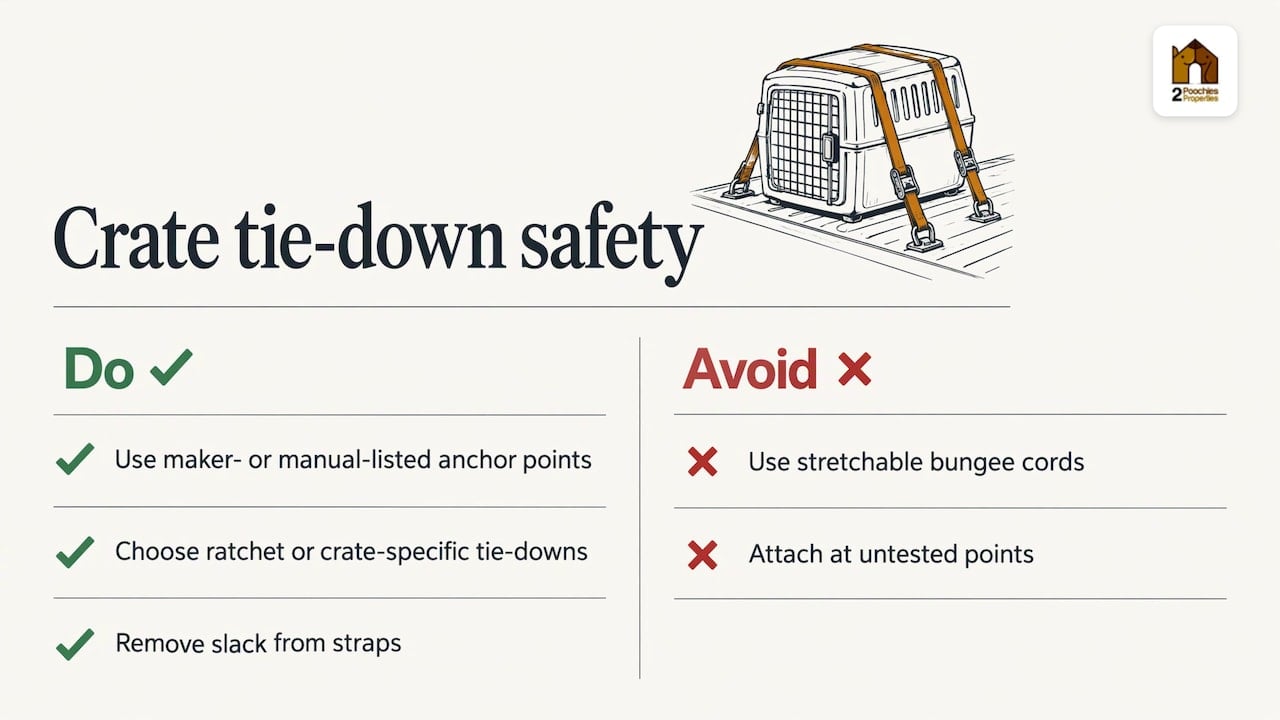
Use the tie-down points the crate maker specifies, or anchor points listed in your vehicle owner’s manual. Ratchet straps or crate-specific tie-downs are better than bungee cords, which stretch. Attach only at points the maker has tested, and remove slack.
Step 3: Test it
Push and pull the crate firmly. It should barely move. If it shifts, tighten the straps or change the position.
Step 4: Recheck on the road
Straps loosen with vibration. The Safety Behind the Wheel Foundation advises rechecking at every stop on long trips, and doing a monthly inspection of your restraint gear if you travel often.
Step 5: Keep the cabin safe
Keep the crate door latched, the dog’s leash off the crate bars, and the windows high enough that nothing can get out or in. Avoid piling luggage on top of the crate unless it is strapped separately.
Getting your dog ready for a long car ride
A crate your dog already likes will make the drive calmer. Cornell recommends acclimating a dog gradually with short, positive sessions of 5 to 10 minutes. Start with very short rides, out the driveway and down the street, and finish somewhere your dog enjoys.
The CDC advises a series of short drives with gradually increasing time. Here is a simple build-up:
- Week one: let the dog eat or nap in the crate at home with the door open.
- Week two: secure the crate in the car, with the engine off, and give treats.
- Weeks three and four: take ten-minute drives to a park or trail, then 30 minutes, then an hour.
The morning of the drive
- Feed 3 to 4 hours before leaving. The CDC and the ASPCA both give this timing, which helps prevent car sickness and vomiting.
- Exercise first. Cornell recommends physical activity before the trip so your dog is ready to rest.
- Pack for the dog. The CDC’s list includes water, food, bowls, a leash, waste bags, medication, first-aid supplies and travel documents, including proof of rabies vaccination. The ASPCA suggests bottled water, because unfamiliar tap water can upset a dog’s stomach.
On the road
Stop every 2 to 3 hours, as Rex Vet advises, for water and a walk. Clip the leash on before you open the door. Never leave your dog in a parked car. Rex Vet reports that on a 70°F day the inside of a parked car reaches roughly 90°F in 10 minutes and over 100°F in 30, with windows cracked or not.
Plan your stops before you leave. If you want a calm arrival plan for the pet’s first hour somewhere new, this guide to moving pets without the chaos has useful routines you can adapt for a vacation stay.
Motion sickness and travel anxiety
Some dogs struggle even in the best-fitted crate. The Merck Veterinary Manual lists the signs: salivation, lip licking, whining, restlessness such as panting, turning, circling or digging, and lethargy. Severely affected dogs may vomit or have diarrhea. Signs usually disappear once the car stops.
What helps:
- A light meal 3 to 4 hours before leaving, a cool cabin, and a forward-facing crate, as Rex Vet recommends.
- Short drives to pleasant places, so the car stops meaning only the vet.
- Rex Vet notes that motion sickness is most common in puppies, and many dogs outgrow it by about one year of age.
If conditioning is not enough, talk to your veterinarian before the trip. Merck describes maropitant as the FDA-approved preferred treatment for motion sickness in dogs. It must be given ahead of travel, not after your dog is already sick. Never give your dog a human medication without your vet’s guidance. Anxiety is different from nausea, so ask your vet which one you are dealing with. A dog that paces, shakes or tries to escape before the engine even starts may be anxious rather than carsick.
Arriving: the best part of the trip
A long drive ends better when the place you arrive is ready for your dog. For us, that is the point of Smith Lake. Lewis Smith Lake is a large reservoir in northern Alabama, and our homes sit right on it. When you pull in, you can open the crate and let your dog stretch in a fenced yard rather than hunting for a patch of grass beside a parking lot.
For the first hour after arrival:
- Leash your dog and walk the yard boundary together before the luggage comes out.
- Set up the dog bed and water bowl in a quiet corner, so there is a settled spot right away.
- Take the crate in if your dog likes it, as a familiar den.
- Offer a small meal and plenty of water once the dog has rested.
If you are comparing places to stay, our guides on pet-friendly rentals versus hotels and rentals with a fenced yard explain what to look for.
Stay with us at Smith Lake
Our pet-friendly lakefront homes are professionally cleaned, with allergy-friendly interiors, fully equipped kitchens and fenced yards. Dog beds and cleanup stations are provided for your pet. Days at the lake can include swimming off the dock and pontoon boat outings with the whole family, dog included. You deal with us directly, so you get personalized service and the savings that come with booking direct.

See the homes and contact us to plan your stay, or browse pet-friendly houses for rent on Smith Lake.
Our perspective
We host dogs for a living, so we think about the car ride as the first chapter of the vacation. A dog that travels securely and arrives calm settles into a new place faster. That is why we build our homes around the arrival: a fenced yard to stretch in, dog beds and cleanup stations ready to use, and interiors that are cleaned professionally and kept allergy-friendly.
We also believe the easiest trip is the one you plan with a person, not a form. When you book direct, you talk with us about your dog, your group and your arrival day, and you save by skipping the middlemen. Questions about the yard, the dock or the pontoon outing get answered by the people who run the homes.
Strap the crate in, plan your stops, and let us handle the lakefront.
2Poochies Properties
FAQ
Where is the safest place for a dog crate in a car?
In an SUV, wagon or minivan, put the crate in the cargo area, flush against the back seats and strapped down. In a sedan, use the back seat or the floor behind a front seat, as Cornell advises. Avoid the front seat because of airbags, and never use an open truck bed.
Can I use a wire crate for car travel?
Collapsible wire crates are not sturdy enough for car travel, according to VCA animal hospitals. Heavy-duty plastic or metal crates give better protection when anchored properly. Whatever you choose, look for independent crash-test results for that exact model and size.
How often should I stop on a long drive with my dog?
Stop every 2 to 3 hours for water and a leashed walk, as Rex Vet recommends. Use each stop to recheck the crate straps. Feed your dog 3 to 4 hours before departure, and never leave your dog in a parked car.
How do I know if my dog is carsick?
Watch for drooling, lip licking, whining, restlessness and lethargy, and sometimes vomiting. Short drives, a light meal beforehand and a cool cabin help. If the problem continues, ask your veterinarian about anti-nausea medication before your next trip.
Can dogs stay with us at the lake?
Yes. Our Smith Lake homes are pet-friendly, with fenced yards, dog beds and cleanup stations. Contact us to book direct and talk through your dog’s needs.
Sources
- CNN Underscored: crash-tested dog crates
- Safety Behind the Wheel Foundation: crash tested pet restraints
- AVMA: policy updates on pet transport
- Rex Vet: traveling with your dog
- CDC: pet travel safety
- Zoetis Petcare: choosing a dog crate
- VCA animal hospitals: crate training and confinement
- Hill’s Pet: traveling with a dog in a car
- Cornell Riney Canine Health Center: traveling safely with your dog
- Progressive: car safety for dogs and cats
- ASPCA: road trip pet safety
- Merck Veterinary Manual: motion sickness in animals
- Wikipedia: Lewis Smith Lake